3000 Calorie Indian Diet Plan for Weight Gain (Veg & Non-Veg)
Two full 3,000 kcal Indian days for healthy weight gain: veg (≈118 g protein) and non-veg (≈159 g), with 6 easy meals and tips to eat more.
 EZMeal team
8 min read
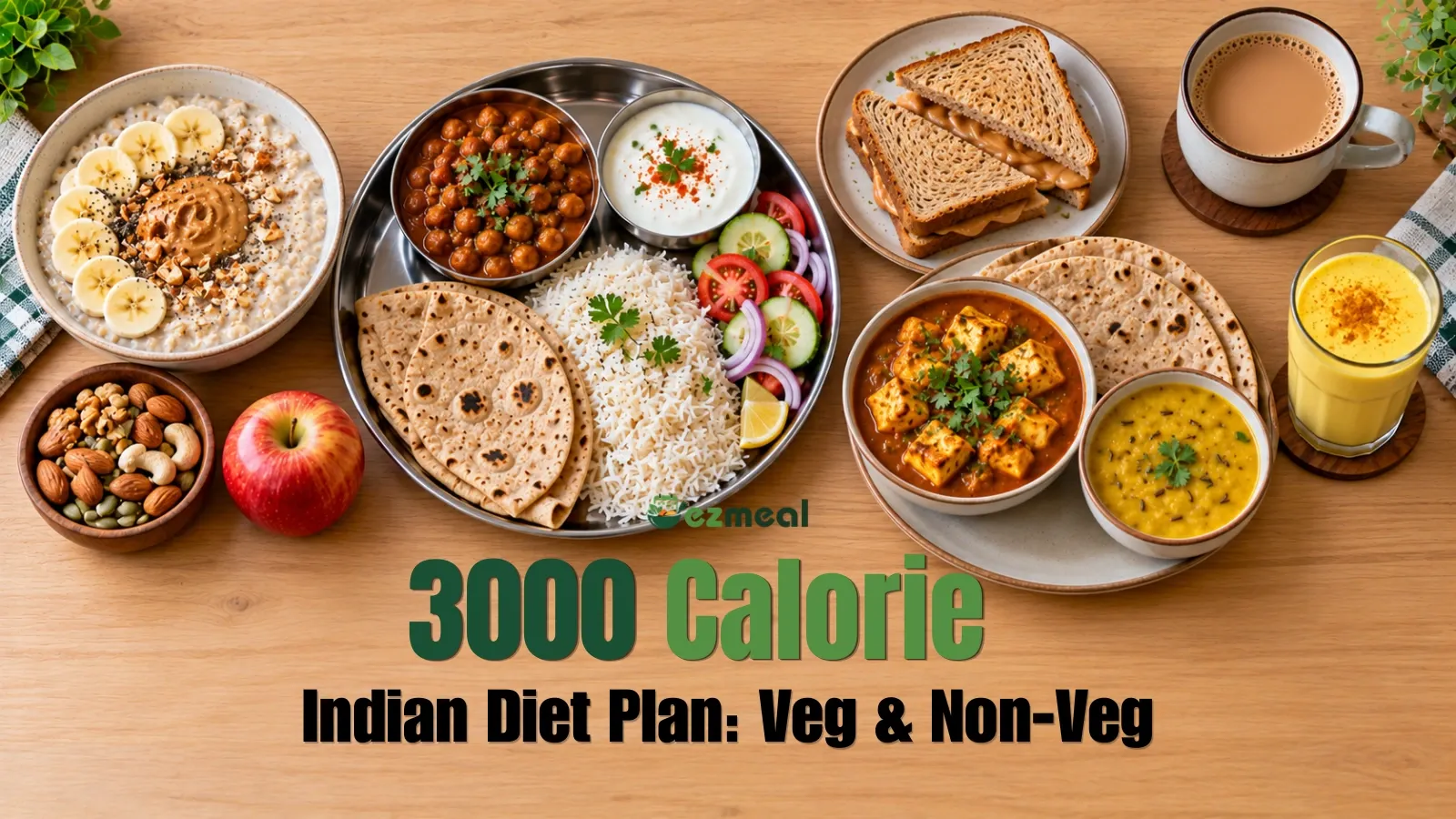
A 3,000 calorie Indian diet plan for weight gain spreads your food over six meals: milk oats with banana and peanut butter for breakfast, nuts and fruit mid-morning, a full thali for lunch, a peanut butter sandwich in the evening, paneer or chicken with rice and phulkas for dinner, and a glass of milk at bedtime. That's about 3,000 kcal with 118 g protein on the vegetarian day, or about 159 g on the non-veg day. It's built for people who struggle to gain: underweight adults, "hard gainers" and very active young men.
Below you'll find two full days, a week of meals, and practical ways to eat more when your appetite is small.
Who is 3,000 calories right for?
You are… | What 3,000 kcal does |
|---|---|
An underweight man (BMI under 18.5) | Steady, healthy weight gain |
A tall or naturally thin man who lifts and isn't gaining on 2,500 | Muscle and weight gain |
A very active man (sport, physical job, training twice a day) | Roughly maintenance |
An underweight woman | Often too much to start with; try the 2500 calorie plan first |
Lost weight without trying, or can't gain however much you eat? See a doctor before increasing calories. Thyroid problems, digestive issues and other conditions can cause this, and they need treatment, not just more food.
If you're under 18, pregnant, or have a medical condition, ask your doctor what's right for you.
Not sure what your number is? EZMeal calculates your calorie and protein target for gaining weight, from your age, height, weight and activity. It's free and takes 3 minutes. Find my calories →
A full 3,000 calorie vegetarian Indian day
A phulka here is a small roti made from 25 g atta, and a katori is a 150 ml bowl. Milk and curd are toned; full-cream milk adds about 60 kcal per glass if you want more.
Meal | What to eat | ≈ kcal | ≈ Protein |
|---|---|---|---|
Breakfast (8 am) | Milk oats: 60 g oats cooked in 300 ml milk, topped with 1 banana, 1 tbsp peanut butter and 2 chopped dates | 635 | 23 g |
Mid-morning (11 am) | 30 g mixed nuts (almonds, walnuts, cashews) + 1 apple | 235 | 5.5 g |
Lunch (1:30 pm) | 3 phulka with 1 tsp ghee + 1 katori rice + 1 katori chole + 1 katori sabzi (1 tsp oil) + 1 bowl curd + salad | 795 | 27.5 g |
Evening (5 pm) | Peanut butter sandwich (2 slices whole-wheat bread, 2 tbsp peanut butter) + 1 cup chai | 400 | 17 g |
Dinner (8:30 pm) | 3 phulka + ½ katori rice + paneer curry (100 g paneer, 2 tsp oil) + 1 katori dal | 835 | 37 g |
Bedtime (10 pm) | 1 glass warm milk (250 ml) with a pinch of haldi | 145 | 8 g |
Total | ≈3,045 | ≈118 g |
Why six meals?
Most people who struggle to gain weight can't eat 3,000 kcal in three sittings. Six smaller meals, about 2–3 hours apart, make the same amount of food feel manageable.
Calorie-dense foods that help
Peanut butter and nuts: about 95 kcal per tablespoon of peanut butter, and about 180 kcal per 30 g of nuts.
Milk and curd: easy calories and protein you can drink.
Ghee: 1 tsp on rotis or dal adds 45 kcal without adding any volume.
Bananas, dates and dried fruit: quick calories for snacks and shakes.
Paneer, soya and chole: protein with plenty of calories.
A full 3,000 calorie non-veg Indian day
Chicken weight is raw and boneless. Milk and curd are toned.
Meal | What to eat | ≈ kcal | ≈ Protein |
|---|---|---|---|
Breakfast (8 am) | 4-egg omelette with onion, tomato and spinach (1 tsp oil) + 3 slices whole-wheat bread + 1 glass milk (250 ml) | 720 | 43 g |
Mid-morning (11 am) | 1 banana + 30 g mixed nuts | 270 | 6 g |
Lunch (1:30 pm) | 3 phulka + 1 katori rice + 1 katori dal + 1 katori sabzi (1 tsp oil) + 1 bowl curd + salad | 745 | 28.5 g |
Evening (5 pm) | Peanut butter sandwich (2 slices bread, 2 tbsp peanut butter) + 1 cup chai | 400 | 17 g |
Dinner (8:30 pm) | 2 phulka + 1 katori rice + home-style chicken curry (200 g breast, 2 tsp oil) + 1 katori sautéed vegetables | 735 | 56.5 g |
Bedtime (10 pm) | 1 glass warm milk (250 ml) | 145 | 8 g |
Total | ≈3,015 | ≈159 g |
Making it work
Too much protein for you? 159 g is more than most people need. If you're under 70 kg, swap 100 g of the chicken for an extra katori of rice. You'll get about the same calories and still plenty of protein.
Thigh or leg instead of breast: adds flavour and some calories, which helps if you're struggling to gain.
Fish or mutton: use 200 g fish, or about 150 g lean mutton once a week, in place of chicken.
4 eggs a day: fine for most healthy adults. If you have high cholesterol or heart disease, use 2 whole eggs + 4 whites and check with your doctor.
One week at a glance
Keep the six-meal rhythm every day: breakfast, mid-morning nuts and fruit, lunch, evening snack, dinner and bedtime milk. The table shows the three main meals; days marked NV use the non-veg day.
Day | Breakfast | Lunch | Dinner |
|---|---|---|---|
Mon | Milk oats + banana + peanut butter | Phulka, rice, chole, sabzi, curd | Phulka, rice, paneer curry, dal |
Tue (NV) | 4-egg omelette + toast + milk | Phulka, rice, dal, sabzi, curd | Phulka, rice, chicken curry |
Wed | 2 aloo-paneer paratha + curd + milk | Rice, sambar, poriyal, curd, papad | Soya pulao + raita + dal |
Thu (NV) | Egg bhurji + 3 phulka + milk | Home chicken biryani + raita + salad | Phulka, rajma, rice |
Fri | 4 idli + sambar + peanut chutney + milk | Phulka, rice, rajma, curd | Paneer tikka + phulka + rice + dal |
Sat (NV) | Masala oats + 3 boiled eggs + milk | Rice, fish curry, sabzi, curd | Phulka, egg curry, dal, rice |
Sun | Poha with peanuts + banana shake | Phulka, rice, dal makhani, salad | Vegetable pulao + paneer bhurji + raita |
Evening snack ideas to rotate: peanut butter sandwich, banana-peanut milkshake, paneer sandwich, roasted chana with peanuts, or 2 pieces of peanut chikki with a glass of milk.
Want all 7 days with exact portions and a grocery list? EZMeal builds your week around your calorie target for weight gain, veg or non-veg, using foods you already eat. Day 1 is free; the full 7-day plan is ₹149, once. Create my free plan →
How to eat more when you're not hungry
Drink some of your calories. A banana-peanut milkshake (about 330 kcal) is far easier to finish than the same calories as food.
Add calories without adding volume. A teaspoon of ghee on dal, a spoon of peanut butter in oats, or nuts sprinkled on poha each add 45–100 kcal you'll barely notice.
Eat on a clock, not on hunger. Set reminders every 2–3 hours. If you have a small appetite, it won't remind you on its own.
Don't drink water just before meals. It fills your stomach. Drink between meals instead.
Build up slowly. If you eat about 2,000 kcal now, try 2,500 for two weeks, then move to 3,000. Your appetite adjusts over time.
Lift weights. Training increases appetite, and it helps make sure the weight you gain is muscle, not just fat.
Mistakes when trying to gain weight
Filling up on junk. Samosas, pastries and cold drinks add calories but crowd out protein and nutrients. Keep them occasional, not daily.
Too little protein. Gaining weight without enough protein mostly adds fat. Aim for about 1.6 g per kg of body weight, using our protein in Indian foods chart.
Eating big one day, little the next. Weekly totals matter. Two good days and one missed day add up to a slow week.
Expensive mass gainers. Milk, bananas, oats and peanut butter do the same job at a fraction of the cost.
Not tracking. Most people who "eat a lot" are eating 2,000–2,200 kcal. Track for two weeks before deciding you're a hard gainer.
Ignoring a medical cause. If you can't gain despite eating well, see a doctor.
FAQ
How much weight can I gain on 3,000 calories a day?
It depends on how far above your maintenance you are. Most underweight people gain about 0.25–0.5 kg a week at first. If you lift weights, aim for the slower end so more of it is muscle.
Is a 3,000 calorie diet healthy?
Yes, when it comes from home food like dal, rotis, rice, milk, paneer, eggs, nuts and fruit, and you need that many calories. It's not healthy if your body doesn't need it; for most people with desk jobs, it would lead to fat gain.
Can a vegetarian gain weight on an Indian diet?
Yes. The vegetarian day above gives about 3,000 kcal and 118 g protein from milk, oats, peanut butter, nuts, chole, paneer and dal. Soya chunks and whey make it easier to raise protein further.
Should I eat 3,000 calories if I'm skinny but have a belly?
Usually not. That's often a sign of low muscle and some extra fat. Start at maintenance or a small surplus, around the 2500 calorie plan, lift weights, and keep protein high.
Do I need a mass gainer to gain weight?
No. A homemade shake of 300 ml milk, 1 banana, 1 tbsp peanut butter and 30 g oats gives about 480 kcal and 18 g protein, often cheaper and with less sugar than many mass gainers.
What should I do if I can't gain weight even after eating more?
Track your food for two weeks to check your real intake. If you're truly eating 3,000 kcal and still not gaining, see a doctor. Thyroid problems and digestive conditions can make gaining hard.
Sources
ICMR-NIN: Dietary Guidelines for Indians (2024)
ICMR-NIN: Nutrient Requirements for Indians (2020)
Food values: Indian Food Composition Tables (IFCT 2017), ICMR-NIN
This article is general information for healthy adults, not medical advice. If you have a health condition, are pregnant or take regular medication, speak to your doctor or a registered dietitian before changing your diet.