ICMR My Plate for the Day Explained: Real Indian Meals
ICMR-NIN's My Plate in katoris and rotis: the official 2,000 kcal plate, 1,500 and 1,800 kcal versions, and a full day of Indian meals.
 EZMeal team
10 min read
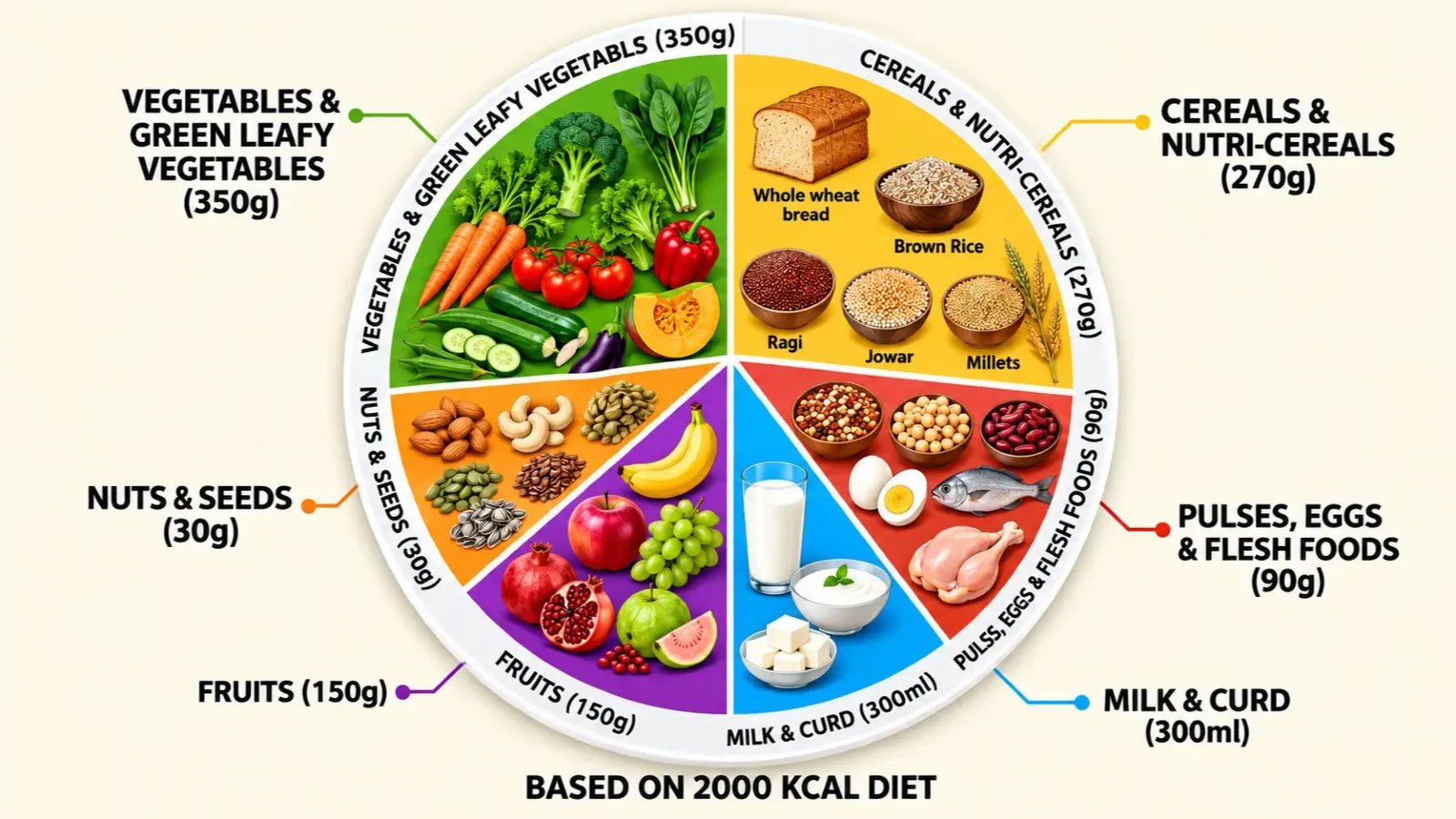
ICMR-NIN's "My Plate for the Day" is India's official model of a balanced 2,000 kcal day: 250 g cereals and millets, 85 g pulses (or eggs, fish, meat), 300 ml milk or curd, 400 g vegetables including greens, 100 g fruit, 35 g nuts and seeds, and 27 g oil — all weighed raw. In everyday terms, that's about 8 rotis' worth of grain (for example 5 roti, 1 katori rice and a bowl of poha), 3 katori dal, 2 servings of dairy, 3–4 katori vegetables and salad, 1 fruit, a handful of nuts and 5–6 teaspoons of oil.
The National Institute of Nutrition (ICMR-NIN) in Hyderabad created My Plate to show how much of each food group an Indian adult needs. It is the basis of the Dietary Guidelines for Indians, released in 2024. You’ll also see it called the ICMR food plate, the NIN plate or “My Plate of the Day”. They all mean the same model.
The problem: the official version is a poster of grams and percentages. Nobody weighs 250 g of atta. This guide converts the plate into katoris, rotis and a full day of meals, adds 1,500 and 1,800 kcal versions, and shows where most Indian diets fall short.
The official My Plate numbers
This is the plate as published by ICMR-NIN for a ~2,000 kcal day. Weights are raw (uncooked) food.
Food group | Amount per day | ≈ kcal | ≈ Protein (g) | Share of calories |
|---|---|---|---|---|
Cereals and millets (incl. nutri-cereals) | 250 g | 843 | 25 | 42% |
Pulses (eggs, fish or meat can replace part) | 85 g | 274 | 20 | 14% |
Milk / curd | 300 ml | 216 | 10 | 11% |
Vegetables incl. green leafy vegetables | 400 g | 174 | 10 | 9% |
Fruits | 100 g | 56 | 1 | 3% |
Nuts and seeds | 35 g | 181 | 6 | 9% |
Fats and oils | 27 g | 243 | — | 12% |
Total | ~1,200 g | ~2,000 | ~72 |
A few rules come with the plate: vegetables exclude potato, fresh fruit is preferred over juice, and you should rotate oils, vegetables, fruits and nuts for variety. NIN describes the plate as a model for healthy adults, not a therapeutic diet for any medical condition.
What the grams look like on your plate
Use these conversions to read the plate in everyday Indian portions. A katori here means a 150 ml bowl.
Food group | Daily amount | Everyday equivalent |
|---|---|---|
Cereals and millets | 250 g raw | 1 roti = 30 g atta · 1 katori cooked rice = 50 g raw · 1 plate poha or upma = 40–50 g. So 250 g ≈ 8 roti, or 5 roti + 1 katori rice + 1 plate poha |
Pulses | 85 g raw | 1 katori cooked dal, rajma or chole ≈ 30 g raw · 2 moong or besan chilla ≈ 50 g. So 85 g ≈ 3 katori dal, or 2 katori dal + 1 bowl sprouts |
Milk / curd | 300 ml | 1 glass milk (150 ml) + 1 bowl curd (150 g), or 2 glasses chaas + 1 cup milk tea |
Vegetables | 400 g raw | 2 katori cooked sabzi + 1 plate salad, with at least one serving of greens (palak, methi, sarson, bathua) |
Fruits | 100 g | 1 small apple, orange, guava or banana, or 1 bowl papaya |
Nuts and seeds | 35 g | 10 almonds + 1 tbsp peanuts + 1 tbsp seeds (flax, til, pumpkin) |
Fats and oils | 27 g | About 5–6 teaspoons in total across all cooking, including ghee |
A full day on My Plate (≈2,000 kcal, vegetarian)
This North Indian day hits every My Plate amount. It gives roughly 2,000 kcal and 70 g protein.
Meal | What to eat | Plate groups covered |
|---|---|---|
Breakfast | Vegetable poha (50 g poha, peas, carrot, 10 g peanuts) + 1 glass milk (150 ml) | Cereal 50 g · veg 50 g · nuts 10 g · milk 150 ml |
Mid-morning | 1 guava or apple + 10 almonds | Fruit 100 g · nuts 12 g |
Lunch | 2 roti + 1 katori rice + 1 katori toor dal + 1 katori palak sabzi + salad | Cereal 110 g · pulses 30 g · veg 200 g |
Evening | Moong sprouts chaat (25 g moong, onion, tomato, lemon) + 1 tbsp roasted seeds + chai | Pulses 25 g · veg 25 g · seeds 10 g |
Dinner | 3 roti + 1 katori rajma + 1 katori mixed veg sabzi + 1 bowl curd (150 g) | Cereal 90 g · pulses 30 g · veg 125 g · curd 150 g |
Across the day | About 5–6 tsp oil or ghee in total for cooking | Oil 27 g |
If you are trying to lose weight, NIN suggests cutting down on cereals first. Dropping the katori of rice at lunch saves about 170 kcal and gives you the 1,800 kcal version below.
1,500 and 1,800 kcal versions
The official plate is built for 2,000 kcal. NIN advises that people who need fewer or more calories should adjust cereals and pulses, while keeping vegetables, fruit and milk the same. The two lower versions below follow that rule; for 1,500 kcal we also trim nuts and oil slightly. These are EZMeal's adaptations, not official NIN plates.
Food group | 2,000 kcal (official) | 1,800 kcal | 1,500 kcal |
|---|---|---|---|
Cereals and millets | 250 g (≈ 8 roti) | 200 g (≈ 6–7 roti) | 150 g (≈ 5 roti) |
Pulses | 85 g (≈ 3 katori dal) | 85 g | 75 g (≈ 2.5 katori) |
Milk / curd | 300 ml | 300 ml | 300 ml |
Vegetables | 400 g | 400 g | 400 g |
Fruits | 100 g | 100 g | 100 g |
Nuts and seeds | 35 g | 35 g | 30 g |
Fats and oils | 27 g (5–6 tsp) | 27 g | 20 g (4 tsp) |
≈ Calories | 2,000 | 1,820 | 1,530 |
≈ Protein | 72 g | 67 g | 59 g |
Roughly who each suits: 1,500 kcal for many women aiming to lose weight; 1,800 kcal for less active men or active women; 2,000 kcal or more for active men and those maintaining weight. Want the 1,500 kcal version turned into real meals? See our 1500 calorie vegetarian Indian meal plan for a full day. Your own needs depend on age, size and activity — EZMeal calculates them for you.
Not sure if you need 1,500, 1,800 or 2,000 kcal?
EZMeal works out your calorie and protein targets from your age, height, weight and activity, then builds Day 1 of your plan free. It takes about 3 minutes.
Find my calories →
South Indian and non-veg swaps
My Plate works with any regional cuisine — it counts food groups, not specific dishes.
South Indian kitchen
Instead of | Use | How it counts |
|---|---|---|
Poha breakfast | 3 idli + 1 katori sambar | Idli batter is rice + urad dal, so it counts as both cereal and pulse; sambar adds dal and vegetables |
Roti at lunch | 1–1.5 katori rice (or ragi mudde, red rice) | Same cereal amount; millets like ragi add calcium and fibre |
Toor dal | Sambar or rasam + kootu (dal-and-vegetable stew) | Kootu often carries most of the pulse and vegetable portion |
Curd at dinner | Curd rice with cucumber | Covers dairy and part of cereal |
Peanuts | Peanut or sesame chutney | Counts toward nuts and seeds |
Non-vegetarian
NIN allows eggs, fish or meat to replace part of the pulses. In practice, swap one katori of dal for 2 eggs or about 75–100 g of fish or chicken. Keep the other pulse servings — dal adds fibre that animal foods don't. Prefer fish, eggs and chicken over red and processed meat.
A full day on My Plate (≈2,000 kcal, non-vegetarian)
This day swaps part of the pulses for eggs and chicken, as NIN allows, and keeps one katori of dal for fibre. It gives roughly 2,000–2,100 kcal and about 90 g protein, more than the veg day.
Meal | What to eat | Plate groups covered |
|---|---|---|
Breakfast | 2-egg omelette with onion, tomato and spinach + 2 slices whole-wheat bread + 1 glass milk (150 ml) | Cereal 60 g · eggs (protein) · veg 50 g · milk 150 ml |
Mid-morning | 1 orange or guava + 10 almonds | Fruit 100 g · nuts 12 g |
Lunch | 2 roti + 1 katori rice + 1 katori dal + 1 katori bhindi or cabbage sabzi + salad | Cereal 110 g · pulses 30 g · veg 200 g |
Evening | Roasted chana and peanuts (15 g + 10 g) + 1 tbsp roasted seeds + chai | Pulses 15 g · nuts and seeds 20 g |
Dinner | 2 roti + chicken curry (100 g raw chicken) + 1 katori palak or mixed veg + 1 bowl curd (150 g) | Cereal 60 g · chicken (protein) · veg 150 g · curd 150 g |
Across the day | About 5–6 tsp oil or ghee in total | Oil 27 g |
Fish instead of chicken: use 100 g rohu, surmai or pomfret. It’s lighter in calories and adds omega-3 fats.
Keep it lean: choose a home-style curry over butter chicken. Count the omelette oil in your 5–6 teaspoons.
ICMR My Plate vs USDA MyPlate vs Harvard Healthy Eating Plate
All three fill about half the plate with vegetables and fruit. ICMR’s version is the only one built around Indian foods and given in grams.
ICMR My Plate (India) | USDA MyPlate (US) | Harvard Healthy Eating Plate | |
|---|---|---|---|
Made by | ICMR-National Institute of Nutrition | US Department of Agriculture | Harvard T.H. Chan School of Public Health |
Food groups | 7: cereals and millets, pulses, milk, vegetables, fruits, nuts and seeds, oils | 5: vegetables, fruits, grains, protein, dairy | Vegetables, fruits, whole grains, healthy protein, plus healthy oils and water |
How amounts are given | Grams of raw food for a 2,000 kcal day | Cups and ounce-equivalents | Plate proportions, no amounts |
Dairy | 300 ml milk or curd daily | A serving with each meal | Limited to 1–2 servings a day |
Fits Indian food? | Yes: dal, roti, rice, millets, sabzi | Needs translating | Needs translating |
If you eat Indian food, ICMR’s plate is the most practical. Its portions convert straight into katoris and rotis.
Where most Indian diets fall short
NIN's What India Eats report compared national diet survey data with My Plate. The pattern is clear: too much from cereals, too little from pulses, and not enough vegetables, milk, nuts and fruit.
Food group | My Plate (kcal/day) | Urban average (kcal/day) | Rural average (kcal/day) |
|---|---|---|---|
Cereals and millets | ~843 | 998 | 1,358 |
Pulses and legumes | ~274 | 119 | 144 |
Visible fats and oils | ~243 | 265 | 145 |
The Dietary Guidelines for Indians (2024) estimate that 56.4% of India's total disease burden is linked to unhealthy diets.
The three easiest fixes for most people:
Add a katori of dal or sprouts to one more meal a day — most diets get less than half the recommended pulses.
Fill half your plate with sabzi and salad before the roti or rice.
Add a daily handful of nuts or seeds and one piece of whole fruit.
FAQ
What is ICMR's My Plate for the Day?
It's ICMR-NIN's model of a balanced daily diet for an Indian adult eating about 2,000 kcal. It sets amounts for 7 food groups: 250 g cereals, 85 g pulses, 300 ml milk or curd, 400 g vegetables, 100 g fruit, 35 g nuts and seeds, and 27 g oil.
How many rotis does ICMR recommend per day?
ICMR gives grams, not rotis. Its 250 g of cereals equals roughly 8 rotis' worth of grain at 2,000 kcal — split across roti, rice, poha or millets. At 1,500 kcal that drops to about 5 rotis' worth.
How much protein does My Plate provide?
About 72 g a day at 2,000 kcal, mostly from cereals (25 g), pulses (20 g), milk (10 g) and vegetables (10 g). That meets ICMR's protein needs for most adults.
Is My Plate good for weight loss?
It's designed for balanced nutrition, not weight loss, but NIN notes that people trying to lose weight can cut down on cereals. Reducing cereals while keeping vegetables, pulses and milk the same lowers calories without losing nutrients.
How much oil per day does ICMR recommend?
About 27 g of total fat and oil at 2,000 kcal — roughly 5–6 teaspoons across all cooking, including ghee. ICMR also advises rotating different oils.
Is My Plate suitable for diabetes or other conditions?
NIN says the plate is a model for healthy adults and not a therapeutic diet. If you have diabetes, kidney disease or another condition, ask your doctor or a registered dietitian to adapt it.
Can I follow My Plate on a non-vegetarian diet?
Yes. NIN allows eggs, fish or meat to replace part of the 85 g of pulses. A simple swap is 2 eggs or 75–100 g of fish or chicken in place of one katori of dal. Keep at least one or two katoris of dal a day for fibre.
How is ICMR My Plate different from USDA MyPlate?
ICMR’s plate is built for Indian diets and gives exact raw weights for 7 food groups, including nuts, seeds and oil. USDA’s MyPlate uses 5 food groups measured in cups and ounces, and is based on American foods.
Sources
This article is general information for healthy adults, not medical advice. If you have a health condition, are pregnant or take regular medication, speak to your doctor or a registered dietitian before changing your diet.